Monday, 30 May 2016

Five reasons to visit Portugal


Cristiano Ronaldo and the Portuguese football team - enough said !


Sunday, 29 May 2016

Contrasting Dublin

We are back in Dublin after our 'potato famine' tour of south west Ireland.

Dublin is a largely Georgian city - just what I like - Georgian architectural symmetry.  Rows and rows of big Georgian windows and red brick elegance.  In contrast, Dubliners are overwhelming young, and despite widespread emigration of young people during the GFC, 40% of the population of Dublin is under 30 years of age. So the place has a real buzz and the city centre is lively with restaurants, bars and music. So much music.

I have previously mentioned that the 1916 rebellion is receiving a lot of commerative attention - even Prince Charles is here doing whatever it is he does. One particular commerative event has caused a bit of stir and debate in the country. Various dignitaries and invited guests attended an event to honour British troops who died during the rebellion.  Mid-ceremony one of the 'guests' jumped up to protest the honouring of what was essentially the occupying forces.  The Canadian Ambassador decided to take action and tackled the protestor to the ground - Wendy Deng style.  This is where the debate kicks in - is he a hero for taking decisive action ? Or as a non-national at an event where he was just another invited dignatory should he have butted out and let the officials deal with the matter. Apparently this chap has been involved in a couple of squirmishes in the past where he has played Action Hero, and he has been lauded for that, but it needs to be noted that these were in his own country and there was some threat involved in those cases. What is being more hotly debated is the appropriateness of the event itself. It was intended as a private and quiet ceremony but the actions of the Ambassador have seen it hit the news big time and people are now asking why it was held at all. I can't help but wonder the outcry if the Japanese held an event in say Singapore to honour their war dead ?? 

On this trip we have seen both sides of Dublin - literally. The poor and the posh. Our first night was spent in the working class suburb of Tallaght (so we could get away on the motorway quickly in the morning). The area was bleak and everything I expected of post GFC Ireland. Including Travellers. No, I do not mean fellow tourists. The Travellers, or gypsies as we called them when I was young and we did
 not know the term was perjorative, number around 22,000 in the Republic. Unemployment is high at 75% and life expectancy low, only half live past 39 years. On every demographic scale they are a sad lot. We encountered a few Travellers on our travels, and the sterotypes all fitted what I had learned watching those voyeristic British TV shows (surely you have seen My Fat Gypsy Wedding).

On our return to Dublin we stayed in the leafy inner suburbs. Our B&B was typical of the area, a large, spacious home with a generous garden where the grey squirrels frolicked.


Next stop - Portugal.

Saturday, 28 May 2016

Genealogy

Apart from enjoying the food, weather and genial hospitality of the Irish the other reason for coming to Ireland was to find my roots.

My great grandmother Mary Shannon came to Australia in 1863 from County Cork as part of the great diaspora that left Ireland to escape the poverty that followed the potato famine of the previous decade. The greatest tragedy of the potato blight is that the disastrous consequences were avoidable. When landlords realised that tenant farmers would not be able to pay their rent due to the crop failure, rather than assist the farm tenants they chose to ship their grain overseas to recoup the cost of lost rent. The British government compounded the matter by refusing to recognise the gravity of the situation. Indeed British Prime Minister, Robert Peel, downplayed the magnitude with the dismissive reference to "the Irish tendency to exaggerate".

Mary Shannon 1885

Mary emigrated when she was 17 with her elder sister Ellen, who was 20, from Liverpool.  I know this by virtue of a family history compiled by a cousin of Mum's (Mary Shannon McCracken), Harley White, and some 'on the ground' research by another cousin, John Greenwood, who visited Ireland back in the '70s. The hand typed history and hand drawn family tree, accompanied by a few grainy photos, has been a most useful reference for my research. And despite some hours at the commuter and with Ancestry.com on line I hadn't been able to advance my knowledge much.

Many Irsih immigrants left for Australia from England. The first screw driven, metal hulled steamship, the Great Britain, which we saw in Bristol, made thirty two voyages to Melbourne and Sydney.

Things must have been miserable in Ireland for them to take this desperate step, and they probably were, as only a few years before in 1846 and 47 the country had been ravished by the Great Famine which was particularly harsh in Southwest Cork, where hundreds of thousands died from starvation or the accompanying diseases.  They must have felt the opportunities in Australia were far greater, and they followed literally millions of other Irish who emigrated in the years of the famine, and those following, to the Americas and to the Antipodes.  

When Mary emigrated her father, Richard, anxious about his daughters' welfare in the colonies, wrote to an acquaintance from the same part of Cork, Jonhn Sweetnam, asking him to look out for her.  Within 18 months, despite a 14 year age difference, they had married, eventually settling down on a farm in Western Victoria, near Rupanyup.  Ancestry.com has good records from Australia, e.g. a copy of Mary and John's marriage certificate, but there are few records extant from Ireland at the time.   The Irish census records before 1900 were destroyed in a fire in the records office, and things like births, deaths and marriages were recorded in the parish records. Finding anything more about either family back in Ireland is therefore difficult. One of the resources I had was the family tree from Harley's biography, see below. 


One useful resource is the Skibbereen Heritage Centre. In addition to a chilling account of the effects of the Great Famine in Skibbereen and the surrounding countryside, vividly presented at the centre,  their website has some useful references. For example, one of the photos in Harley's biography was of the ruins of the Aughadown Church.  Both, John and Mary, being the decendants of English migrants to Ireland were members of the Church of Ireland (the local branch of the Church of England).  And the Aughadown church on the banks of the river Ilen in Aughadown was probably their local church.  The centre has a survey of the graves at this site. Jo and I found the church, down a typically narrow Irish local road, and surveyed the graveyard. There are many stones with the names from our family history, Shannon, Sweetnam, Trinder and Swanton. But many are barely readable and I couldn't match any to the likely dates of our family members.


Ruins of the Church of Ireland church at Aughadown 

Records from the parishes of the Church of Ireland do stil exist but none from Aughadown have survived. Another resource that has, however, are the tithe records. Members of the church paid a tithe to maintain the church and also fund the local school. I learned this from Margaret a genealogist at the Skibbereen centre whom I was lucky enough to have some time with during our visit. The tithe was paid according to the amount of land each member of the church owned, or more commonly rented from the local landowner.  So the owners or tenants of each plot in each parish are recorded. A brief search through these records reveals many of the names that appear in our family history but I will need to spend some more time researching these for possible antecedents.

Harley's history does identify the farm on Roaring Water Bay where Mary grew up, Ardnagroghery, a demesne  of the nearby farm of Whitehall. The building regions although now appears to be used as a shed on the farm, which now has a new home built on it.  


The Shannon farm at Ardnagroghery, Aughadown, County Cork


Friday, 27 May 2016

England may be picturesque but Ireland is positively photoshopped

Irish poets wax lyrical about the beauty of the Irish coast and countryside with good reason.


Even the cows have views 
Bluebells so blue they must be photoshopped.

Happenstance can be a joyous thing - who would have thought we would luck out and discover the International Fly Fishing competition launching off when we visted Lough Derg. Who would have known how big fly fishing was. The International Fly Fishing Association has been around since 1931, but as it only includes Ireland, Scotland, England and Wales we can be forgiven for our ignorance. 


The splendid Bantry House was the seat of the English Earls of Bantry.  Diana the Huntress guards the entrance to the property


These magincifent blooms are rhododendrons


But a house is not a home unless it has an Outback BBQ!


Thursday, 26 May 2016

Beannachtai o Eirinn

Greetings from Ireland

We arrived in Dublin on Sunday - to rain. Not surprising, as in Ireland over half the days of the year qualify as wet days (over 1mm). But we made a pact not to complain about the weather and just get on with it, and since doing so we have been blessed with no more rain and some days the sun has actually peaked through the clouds for periods of time.  I think the Irish must be essentially optimistic people as the dress shops are replete with summer frocks. So they must expect some sun over the coming summer. Tom thinks the summer dresses are only intended for their holidays to Alicante and Majorca. 

According to an article in today's Irish Examiner Irish people are not getting enough vitamin D, and I have seen enough scarily lily white legs on the locals to confirm that they do not seem to be getting much sun.  The Examiner quotes a leading nutritionist (why is it that the media only ever quote a 'leading' expert, never just an ordinary run of the mill one?) who states that in countries at this latitude winter sunlight is not sufficient to produce vitamin D and that "we don't always get enough sun during summer". 

True the sun is shinning, but it is cold enough for me to covered head to toe. Another day to pop a vitamin D tablet.  More money to Swisse Pharmacuticals. 

This year marks 100 years since the 1916 Easter rebellion. Ireland history is littered with insurrections against their English overlords since the Medieval English kings arrived to occupy the island.  The 1916 rebellion ushered in a period of intensely violent struggle for Home Rule and lead to the establishment of the Irish Free State five years later. I grew up hearing about the Troubles in Ireland during the 1970s which at that time were centred on the situation in Northern Ireland, or Ulster and I had little or no appreciation of the struggles that lead to the establishment of the Republic of Ireland in 1948.

One of the more horrific stories I have learnt is the story of Croke Park in 1920. At the height of the violence Irish nationalists murdered 14 British troops in their beds. In retribution, British troops opened fire and randomly killed 12 innocent spectators at a football game at Croke Park in Dublin.

So if we are not here for the sun what are we doing in Ireland.

For the past six months Tom has sat up late at night tapping away on the Internet 'researching'.  I know what you are all thinking... The credit card came in with strange payments to international internet sites ... Hmmmmm.  And now I can see what it was all about. Genealogy Porn. It is the new thing, especially for men of a certain age. It is everywhere here. And don't the Americans love it.  By the way they are here is droves.  Bus loads of them turn up - I have heard more American accents than Irish in some of the more touristy places.  

But back to the finding your roots story. Like many Australians whose family pre-date WWII migration Tom has Irish ancestory, I am one of the strange Australians in having no Irish heritage.  SInce we first planned this trip Tom has been capitalising on the work of a distant cousin who looked into the family's antecedents and he has been searching for information of his mother's family. Hence our visit has brought us to the wilds of south west Ireland, but I will leave the story of finding his heritage for Tom to tell in another post.

The ruins of Aughadown church where Tom and Lesley's Irish relatives are buried. I am sure he will tell you all about it in his post.  


Wednesday, 25 May 2016

A gardener's tour of England

I have already warned Tom that when we get home we are digging up the front yard and putting in something like this.


I hope we can also fit in a pitch where I can hone my croquet skills.


Our last days in England were spent mostly in the Cotswolds, an impossibly beautiful part of the world. We made the best of some fine weather and checked out some splendid English gardens, making sure the places we visted served cream tea. 


The Arts and Crafts movement

I had heard this expression before, probably on the Antiques Roadshow channel (I am prone to exaggeration but I swear there is a channel on UK TV that is 24 hour Antiques Roadshow.  Well certainly every time I turned the TV on Fiona Bruce was strutting about being all jolly hockey sticks). In my ignorance my idea of arts and crafts was limited to the Playdoh fun I have with Siena and Jack when minding them. I now know that the Arts and Crafts movement was started by William Morris in the late 19 century.  Morris was bringing up a young family in London as was concerned about the dirty, bustling city and he moved them to Gloucestershire to live a quieter life which eschewed modernity. For Melbourne readers think of the Reeds at Hiede - and yes the Morris household also had its own ménage a trois - what is it with these artistic types. Morris was a textile designer, amongst his other many artistic pursuits, and an early socialist. He promoted the return to hand crafts and away from the machine production of materials that had become common since the development of machines processing in northern England. In short, an early hippy! 


I now know what Edna Walling was on about with her walled gardens and climbing roses.


In stark contrast to the Arts and Craft movement our trip also took in the industrial revolution cities of Manchester, Coventry and Bristol. I have commented in an earlier post on my appreciation of the works of Charles Dickins and visiting the various museums in these 19th century industrial cities puts the horrendous life of the working classes into crisp perspective.


Happy Birthday Tim

HAPPY BIRTHDAY TIM

Today is Tim's birthday and rather than being at home to celebrate with him we are awful parents and are away in Ireland enjoying ourselves and spending his inheritance.

But fortunately Tim's caring Aunt Lesley was on hand to take him out to celebrate for lunch on Sunday and we have done the decent thing and left him a decent gift in our absence. Also thanks to Aldi for the great special on hooded barbecues the week before we departed.

So happy barbecuing Tim.


Tuesday, 24 May 2016

Richard III


My fascination with Richard III began when as a young girl I read Josephine Tey's 1951 detective novel,  Daughter of Time. Tey retells   the mystery of the fate of the Princes in the Tower through the eyes of a modern police officer who investigates the alleged crimes of King Richard. Tey's work challenges the long held belief that Richard did away with his nephews as they posed a threat to his tentative grip on the throne. Tey's work is compelling and I am only one of many readers who have found themselves persuaded by her arguments of Richard's innocence.
You are all familiar with Shakespeare's Richard III - the hunchback Medieval tyrant whose actions are Machiavellian even 50 years before Machiavelli wrote The Prince.  The real Richard III remains a mystery even today and the recent finding of his remains has only added to the mystery and not dispelled any of the myths. So we are now in Leicester to learn more.  The jury is still very much out on Richard, bu what is certain is that the recent discovery of his body and the reinterment in Leicester Cathedral have been a boon for the city.  In the 12 since his reinterment he has boosted tourism to the tune of 55 million pound and his grave is now one of the top 25 new places in the world to visit - up there with the Cern Laboratry in Switzerland and the world's fastest roller coaster in Abu Dhabi.
Richard's tomb is surprisingly moving in it's simplicity and elegance
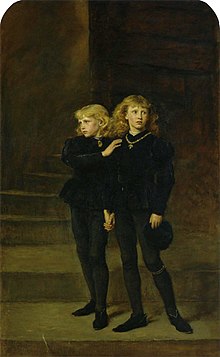
In previous visits to England Leicester never featured in the itinerary but how things have changed since they unearthed Richard's bones, and more recently since the local football team unexpectedly won the English Premieer League this month.  For Australians unused to the complexities of English soccer than means they finished top of the ladder - that is a bigger deal here than at home.

The Two Princes Edward and Richard in the Tower, 1483 by Sir John Everett Millais, 1878. As a young girl I had this image of the young princes as a swap card. Poor Richard, forever considered as Shakespeare's hunchback monster has little hope when compared with the cherubic young princes   

Friday, 20 May 2016

The road to Wembley

Que Serra Serra
Whatever will be will be
We're going to Wembley
To bring home the Cup

Such is the refrain of the fans of the two English football clubs who have made it to the FA Cup Final. Luckily I am in a win-win situation here - either Manchester United win their 12th FA Cup or the cup is won by less fancied London club Crystal Palace, who are captained by Australian, Mile Jedinak (or Mike Jedinak  as he was incorrectly named by ex-Prime Minister Tony Abbott when he publicly congratulated him on captaining the Soccerroos on winning the Asian Cup).  With the Ned Kelly beard he is sporting there is no mistaking Mile is an Australian. So if the Red Devils do not prevail then we can witness the first Australian to hold up the cup as captain.

Australian Socceroos captain Mile Jedinak is congratulated by team mates after converting a penalty

Sadly Tom and I will not be at Wembley - but when United did win their semi-final to advance, yes I did get out Dr Google and have a look at tickets.  Tickets were available, but at 427 quid a ticket even I thought better of it.  But I was impressed to see that the Association frees up an enormous number of tickets for supporters. Wembley holds 90,000 and Manchester United have 28,000 tickets for members.  Furthermore, United has a distribution system that rewards supporters for their loyalty by prioritising those who have attended the most home games in the season.  Fancy that - filling the ground with grass roots supporters - consider that AFL.  Participating clubs in the AFL Grand Final get only 11,000 tickets for supporters in the larger capacity MCG - disgraceful.

The Football Association is the oldest existing football competition in the world, dating from 1871. The first teams were made up of wealthy former public school boy amateurs from the south of England.  


A group of men, most of whom are wearing shorts and football shirts, holding two trophies, one of which is the FA Cup
Blackburn Rovers became the first team from the north to win the cup in 1883, defeating Old Etonians. Upon his team's return to Blackburn, captain Albert Warburton proclaimed: "The Cup is very welcome to Lancashire. It'll have a good home and it'll never go back to London."

The Cup has a long and fascinating history.  I have watched many a Cup in the wee hours and this year we will impose on our English friend Pauline to fire up her telly and watch it in the comfort of her lounge.  I am told that this is not the first time we have watched the Cup live on telly in England. Tom assures me that on our very first visit to England in 1985 we popped into a London pub to watch Manchester United beat Everton.  Frankly, while I have hazy memories of warm beer in a pub on our first day in London I can't recall any part of the game, by which I can only assume that I had a cracking time !  Looking back on the Man U team back in 1985 what is noticeable is that all the players are either from the UK or Ireland - not one Spaniard/Brazilian/Ghanian amongst them.

This is not the first time United and Crystal Palace have faced each other in the Cup. They met in 1990 and the match finished excitedly at 3-3 after extra time. In the replay, United won 1–0.  That was Palace's first Cup appearance and the team they fielded was the last all-English team to play there FA Cup final. It was United's seventh Cup win, seeing them match the records of Aston Villa and Tottenham Hotspur. It proved to be the turning point in Manchester United's history after a few lean seasons; over the next 20 years they collected a total of more than 20 major trophies in England and Europe.


Thursday, 19 May 2016

Reprise


If you have been reading the blog you will know that a highlight of this trip was to be a Manchester United game at Old Trafford, and you will also know that this special occasion was cruelly truncated due to a failed security exercise.

After this fiasco the football club was quick to announc that ticket holders would be refunded and fans could attend the rescheduled game at no cost.  Fair play to Manchester United, as this bid to recover good will with fans has been rumoured to cost them three million pound (I have to write that in long hand as I can't find the symbol keys on the iPad - first world problems).

We were not entirely sure what this would entail. Rationalising the situation we hoped to get a refund of the cost of game entry because in fairness we had managed to enjoy our three hours of VIP hospitality on Sunday - three course lunch, wine, champagne and beer - before being evacuated.  But no - this is the biggest football club in the world (OK, perhaps Barcelona is bigger but the free wifi in this cafe is a bit tenuous and I don't dare stress it out by performing more Google searches) and when they do apologetic compensation they do it in style.

So all six of us were invited back for the rescheduled game AND complementary three course pre-match dinner, wine, champagne and beer; and the club has refunded the full cost of our original tickets.  Regrettably Leonie and Graeme were already in Exeter and it was not viable for them to get back, but Drew found two willing local relatives to volunteer to take their place, and Tom and I made the round trip from Leicestershire for the occasion.


Leonie in her George Best chair on our aborted first attempt to watch the match

Fred the Red, the Manchester United mascot - where do I start 

Drew enjoys some quality one-on-one time with Fred the Red

Fred the Red is the club's mascot and if it is not obvious he is a red devil.  Fred is no ordinary mascot, Fred is a superstar in his own right. When Manchester United played exhibition matches in 2012 in Shanghai Fred had his own security escort to protect him from overzealous, delirious fans! Fred has own Facebook page and if you look him up on YouTube you can see him do a star turn dancing for the crowds at Old Trafford.

Fred is not Manchester United's first mascot and for those of you with some idle time I recommend you check out the Wiki page for Manu mascots. As a blogger you could not hope for better material - the history of the mascots is comedy gold. I shall start with Michael the Bank St Canary who dates from the 1890s.  The club promoted Michael's singing to fans, but sadly Michael could not sing.  Also sadly, Michael was not a canary. Michael was in fact a goose.  Not surprisingly Michael did not last long and he was followed by Major the Saint Bernard, who was the pet dog of one of the players.  On Michael's retirement Billie the Goat became the new mascot.  Billie had been given to one of the players by a theatre company - no, there is no rational reason to explain why.  Billie was popular and successful as mascot and often joined the players visiting ale houses where he enjoyed a tipple. Tragically,this was to be his undoing and Billie died of alcohol poisoning after the 1909 FA Cup win over Bristol. 

It is not until the 1930s that the next mascot appears: Hoppy Thorne the one-legged wonder.  Hoppy was a first war veteran who lost his leg in combat.  Hoppy was a popular mascot with the fans but his relationship with the club soured when he failed to secure tickets to the 1948 FA Cup final and he withdrew his services.


Fred joins the players on the pitch


Wednesday, 18 May 2016

A nice brew

It is time to visit some of the quaint customs of Lancashire, and one of their most important rituals is tea - or as they call it here - brew.

As a drinker who prefers tea to coffee I have been looking forward to being in a country where proper respect is paid to tea, rather than the overblown hype that has now permeated the world and turned everyone into an expert on the coffee bean.

I offered to make tea in our farmhouse accommodation on our first day and I was dismayed to find Drew making tea by placing a spoon of tea in a cup and pouring boiling water on top.  He tells me that is how they make a brew here in Lancashire.  It did not even look like real tea leaves, rather more like granules. They leave the tea in the cup which means the drinker must be careful on reaching the end not to swallow a mouthful of tea leaves. In what almost resembles the Japanese tea ceremony the guest goes to great pains to compliment the host on their brew and then there is much discussion concerning the art of brew.

Even the tea bags havre instructions.


I have stuck to my more traditional tea making style.


Another of the domestic arts that prevails in Lancashire is washing and housework.  The urban landscape here is dominated by the terraced two up/two down. Rows and rows of two storied terraced houses which comprise two downstairs rooms and two upstairs rooms - hence the expression.  The front room windows open straight onto the street and the custom is to leave the curtains open, providing every passer-by the opportunity to gawk into the front room.  The Lancashire house-keeper is a proud sole and windows are spotless and the front room is always in meticulous order so as to pass the scrutiny of judgemental neighbours.  There is no privacy.  Even the backyards are open to the world as the fences are low and from the yard at one of the street you can see all the way up the street into every yard.  Coronation Street lives on.  As the washing is hung out back (more on the lack of definite articles, pronouns and prepositions later) for everyone to see it must be sparkling clean, again to pass the examination of the neighbours.

Our farmhouse accommodation is actually on the large size for this area
Bacup terraces 

My favourite Lancashire quirk is the wash trough, a plastic tub that sits in sink and is used for washing dishes. Why?????  Why not just use the sink? Is this a water saving device, or I ventured that perhaps the drainage was old and it was more efficient to throw the water on the garden. We had many theories. Drew ventured to ask one of his aunts to explain the mysteries of the wash trough and she was perplexed by the question. No one had ever questioned the practice before and she took some time to respond that if you did not use the trough you would have to put in the plug and fill up the sink to wash the dishes - an alternative process that she just considered to be nonsensical. 

I have mentioned the Lancashire/Mancurian treatment of the preposition - or as they would say treatment of preposition. It is like txt speak - they minimise everything.  So they go pub, to have pint, and rather than engaging in lengthy greetings on meeting you they will ask you right? To which you should reply, ah, you right? I quite Iike this economy of speech, and indeed when asked one of the locals explained it exactly as that, though in something more like the following words - if use less words can fit more in when speak.  

But enough of the urban world, let's venture into the rural as this part of the Pennines has a lot to offer in bucolic splendour.  

We tend to think of northern England as belching smoke stacks and child labour chimney sweeps - I may have read too much Dickens.  Tom and I have been out walking and enjoying the dales. Or they may have been the moors; is there really any difference? Wind turbines stand majestically on the dales (or moors) and for me they just add to the pastoral palate blending in with the country scene as they spin around making their green and clean energy. 

Why at home are we told that wind turbines will be the end of the farming industry ?  These sheep are entirely non-plussed by these wind turbines

We found hedgerows and walking paths with styles, horse riders, squirrels and abundant wild flowers. Bulbs self naturalise along the paths and roadways and in addition to daffodils and tulips, bluebells add to this vista. You know bluebells - common in Melbourne gardens, not unattractive but nothing to write home about. Or are they !! Have you heard of the Bluebell Black Market ? (Tom, the wag, thinks it should be called the blue market). It is a national scandal - people stealing bluebell bulbs to sell illegally. Bluebells and this nefarious trade made a two page feature in The Telegraph last week, I kid you not. In a recent raid police seized 5000 rare bulbs headed for the illegal trade.  And to think, after the Southern Hemisphere Spring I will do my annual thinning out of the bluebells in my garden and discard the unwanted ones. If I only I had known, I could have bought them with me to help offset some of the costs of this trip. 


On our morning walk we had to scramble up the verge of this lane to allow the Land Rover which was delivering the milk to pass